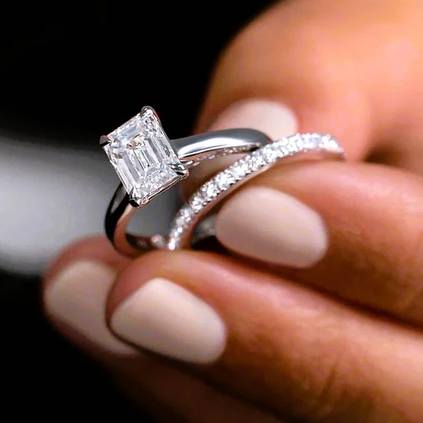
Matching Your Wedding Ring to Your Engagement Ring: A Dallas Designer’s Approach
Nobody warns you about the second ring. Couples spend months choosing an engagement ring, then start band shopping with two weeks to spare. The plan is usually vague; something plain will do. That plan falls apart the moment both rings sit together on one finger. Some pairs look like they were made for each other. Others look like strangers forced to share a seat.
The difference rarely comes down to price. It comes down to design decisions made before either ring was finished. Anyone shopping for wedding rings in Dallas has probably noticed something odd. Bands look similar inside a display case, but then behave very differently next to a real engagement ring. A band that photographs well on its own can still create an awkward gap. It can crowd the setting or throw off the balance of the center stone.
Here is the part most stores skip. The safest way to avoid a mismatched pair is to have both rings designed by the same hands. Shapiro Diamonds Dallas engagement rings are built with the future band in mind, so the second ring is never an afterthought. Lance and Kendra Shapiro have designed more than 30,000 custom rings across 25 years. A surprising share of that work solves one quiet problem. Two separate rings need to read as one piece of jewelry.
Why Some Rings Fight Each Other on the Same Finger
Think about what actually touches what. An engagement ring has a profile, meaning the way the setting rises off the finger and where the metal sits along the band. A low cathedral setting leaves little room underneath. A raised basket leaves plenty. When a flat band meets a setting that flares at the base, the band is pushed away, creating a visible gap.
That gap bothers people more than they expect. You paid real money for both rings, and now daylight shows between them every time you look down. Some couples live with it for years, quietly annoyed. Others buy a third ring to fix the problem, which is an expensive way to learn about profiles.
Start with the Setting, Not The Band
Let’s break it down. The engagement ring has already made most of the decisions for you. Its setting height, bandwidth, and stone shape narrow the field of bands that will sit well beside it. A designer looks at the base of your setting first, because that curve or straight edge determines whether a standard band will sit flush.
Bring the engagement ring to every band conversation, or better, design both at once. A jeweler who built your setting knows its measurements down to the millimeter and can shape a band that nests against it without force. Couples who buy the band from a different store lose that information and end up guessing.
Metal Matching and When to Break the Rule
The old advice says the metals must match. White gold with white gold, platinum with platinum. That rule exists for a practical reason, since different metals wear at different rates and can look mismatched after a decade of daily contact. Platinum develops a soft grey patina while white gold stays brighter with rhodium plating.
The rule still bends. Mixed-metal pairings work when the contrast feels deliberate rather than accidental. A yellow gold band under a platinum solitaire reads as a choice. Two slightly different shades of white metal read as a mistake. If you want contrast, commit to it fully. A designer can also match the alloy of your band to the exact alloy of your setting, which no ready-made band guarantees.
The Contour Band Question
Curved settings raise a fair question. Should the band bend around the engagement ring, or should it stay straight, leaving a gap? Contour bands, sometimes called shadow bands, follow the outline of the setting so the two rings interlock. Done well, they disappear into the set. Done poorly, they only fit one specific ring and look strange worn alone.
Some brides want a band that works solo on travel days or at the gym. A straight band handle handles that job better. Others never plan to separate the pair and prefer the fitted look. There is no wrong answer here, only a wrong assumption, which is that any band will handle both jobs equally well. Decide how you will actually wear the rings before choosing a shape.
Diamonds That Agree with Each Other
Stone quality across both rings matters more than most shoppers realize. A band set with diamonds several color grades below the center stone will look faintly yellow beside it, even to an untrained eye. The reverse also happens. Icy band diamonds can make a warmer center stone look tinted by comparison.
This applies to natural and lab-grown diamonds alike, and both options belong in the conversation. Matching the color and cut quality of the band stones to the center diamond keeps light behavior consistent across the whole set. Buying diamonds at wholesale pricing also means the budget stretches further, so nobody has to downgrade the band stones just to afford the pair.
What a Private Showroom Changes
Retail stores sell bands in cases, and the case decides your options. A private appointment works differently. You sit with a diamond expert or a designer, place your engagement ring on the table, and build the band around what already exists. Nothing gets pulled from mass production, and nothing gets forced into a near-enough fit.
That process takes a conversation instead of an afternoon of browsing. It also removes the commissioned sales pressure that pushes couples toward whatever needs to move that month. The band that left the studio was made in Dallas for one specific ring on one specific hand.
Next Steps Before Your Appointment
Photograph your engagement ring from the side and straight on. Note the metal, the setting height, and how the band feels at its current width. Decide whether the band needs to work alone or only as part of the set. Then bring those answers and the ring itself to a design consultation.
The couple’s happiest with their wedding rings, made both rings part of one plan. The finger does not see two purchases. It sees one story, told in metal and stone, and the two chapters should sound like they came from the same author.
